Can you fly your drone in Greece?
Whether you can fly depends on your drone, your registration and exactly where you fly. Here is what applies: key rules, no-fly zones and the official sources, in one place.
Regulator
Hellenic Civil Aviation Authority (HCAA)
Framework
EU 2019/947 (EASA Open Category) + national enforcement framework
Pilot credential
Operator Certificate
BASIC RULES (EASA OPEN CLASS)
- Maximum 120 m above the ground (EASA Open Category)
- Register as a UAS operator (free), if the drone weighs 250 g or more or has a camera
- A1/A3 online training is required – minimum age 16
- Restricted Archaeological Sites: the Acropolis, Delphi, Olympia, and others
- Always maintain visual line of sight (VLOS) with the drone
- Do not fly over assemblies of people. Rules for uninvolved persons depend on subcategory, class mark and operating conditions; check the official matrix.
- Minimum distance of 8 km from each airport
- Night flight is permitted under the EASA open-category baseline when the required green flashing light is used, unless a current geographic zone or national rule imposes a stricter condition.
- Island airports: Check the DAGR map carefully—many islands have large CTRs
No-fly zones and restrictions
Frequently asked questions
Do I need a licence or certificate to fly a drone in Greece?
Two separate things are easily confused here. Registration as a drone operator is required as soon as your drone weighs 250 g or more, or has a camera or sensor able to capture personal data — so it covers many sub-250 g drones too, unless they qualify for the toy exemption. The Operator Certificate competency certificate is something else: you need it once your drone weighs 250 g or more, or carries a C1 or higher class mark. A camera drone under 250 g therefore needs registration, but no exam. You get the certificate by passing an online theory test with Hellenic Civil Aviation Authority (HCAA), and it is then valid across the whole EASA area, not just here.
Can I fly a drone as a tourist or foreign visitor in Greece?
Yes — EU drone rules apply to visitors too. If you are already registered as a drone operator in another EASA country, that registration and your A1/A3 certificate (also A2) are valid in Greece as well. Coming from outside the EASA area, you register once — in the first EASA country where you plan to fly, here with Hellenic Civil Aviation Authority (HCAA). Every designated archaeological site in Greece is a no-fly zone without prior permission — this covers many famous tourist spots such as the Acropolis. Check the DAGR map before flying, and expect filming permits to involve the Ministry of Culture.
What are the most important drone rules in Greece?
The short version: Maximum 120 m above the ground (EASA Open Category). On top of that: Register as a UAS operator (free), if the drone weighs 250 g or more or has a camera. Also: A1/A3 online training is required – minimum age 16. These are central aviation rules — location-specific airspace, land, nature, privacy and photography requirements can also apply in Greece, so always check the official sources.
Where am I not allowed to fly a drone in Greece?
What you need to avoid are the restricted zones — typically around airports, prisons, military areas and protected nature. You'll find the official map for Greece under Sources below, and the DroneKoll app shows current NOTAMs (temporary airspace restrictions) for Greece.
Who regulates drone flying in Greece?
Drone flying in Greece is regulated by Hellenic Civil Aviation Authority (HCAA), which handles both the rules and the airspace. Their official pages are linked under Sources below — that is where changes appear first.
Good to know
OFFICIAL SOURCES
- HCAA – Regulations on Drones Official rules and information from the Civil Aviation Authority regarding drones hcaa.gov.gr
- HCAA – Pilot Registration Free registration as a UAS operator (valid in all EU/EASA countries) hcaa.gov.gr
- DAGR – Drone Airspace Map Official Geographic Map of Restrictions on Drone Flights in Greece dagr.hasp.gov.gr
- HCAA – Flight Notification Submission of a 5-day advance flight notification (required for each flight) hcaa.gov.gr
ADDITIONAL RESOURCES
Before every flight, always check the official sources of the Hellenic Civil Aviation Authority (HCAA) and the DAGR map. This app is a tool—not a legal authority. Greece follows EASA regulations with national additions, including, among other things, the mandatory 5-day flight notification requirement.
The app
The whole picture, up to date — in your pocket
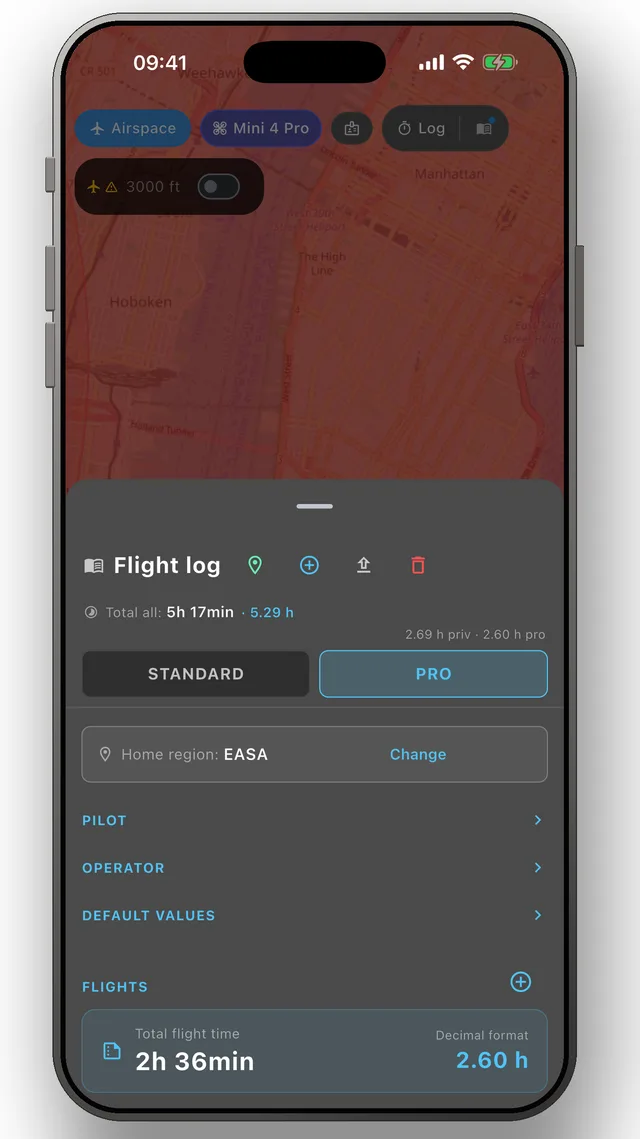
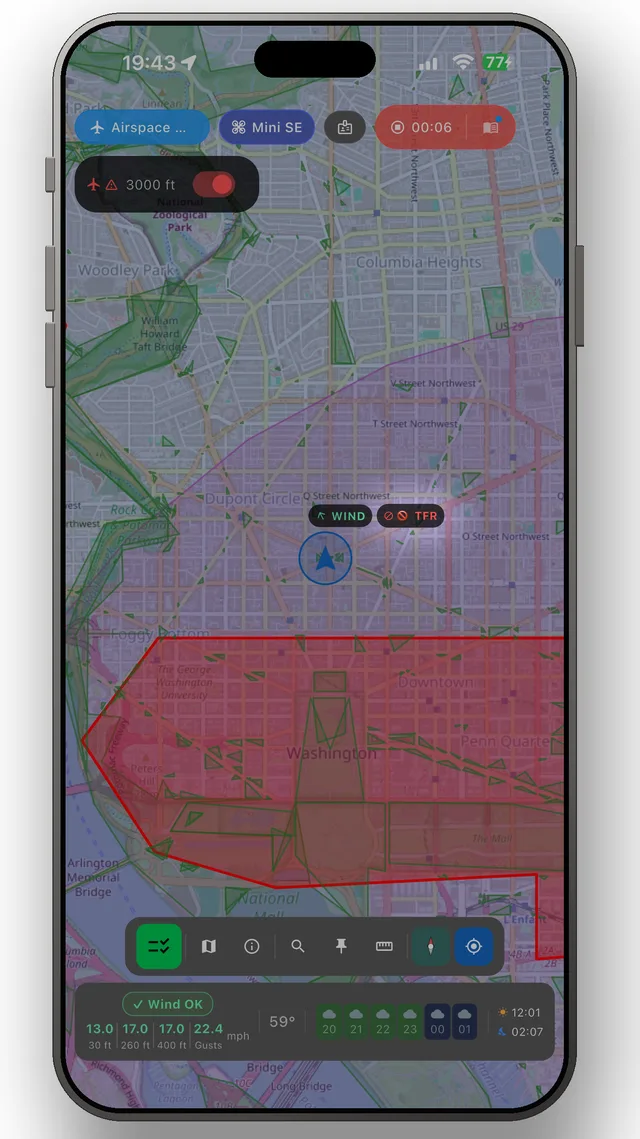
DroneKoll shows weather and current NOTAMs on the map — with flight log and checklists built in.
More in the app: Interactive zone map · Flight log · Planning & measuring · Pre-flight checklists · Flying abroad