Can you fly your drone in Sweden?
Whether you can fly depends on your drone, your registration and exactly where you fly. Here is what applies: key rules, no-fly zones and the official sources, in one place.
Regulator
Transportstyrelsen
Framework
EU 2019/947 + Swedish national rules
Pilot credential
A1/A3 drone certificate
IMPORTANT RULES
- In the open category, the maximum height is 120 m, measured as the distance to the closest point on the ground surface — not just straight down, so near a slope the ground beside you may count. Within 50 m of a tall man-made obstacle (over 105 m), the maximum height may be increased up to 15 m above the height of the obstacle at the request of the entity responsible for the obstacle.
- The operator must normally be registered if the drone weighs at least 250 g or is fitted with a camera or sensor capable of collecting personal data, unless it is covered by the toy exemption. Requirements regarding drone certificates and flight distances depend on the drone’s class, weight and subcategory.
- In Sweden, you must be 15 years old to fly independently with an A1/A3 drone certificate (online theory test with Transportstyrelsen, subject to a fee, valid for 5 years). Anyone under 15 may only fly under the direct supervision of a remote pilot who is at least 16 years old and holds a valid drone certificate themselves.
- The operator number must be clearly marked on the drone.
- In the open category, you must keep the drone within your own unaided visual line of sight (glasses/contact lenses are fine; binoculars or a screen do not count) — or fly with the help of an observer, with clear and effective communication between you at all times, so that together you can scan the airspace and avoid collisions. Follow-me mode is a separate exception, permitted up to 50 m from the pilot.
- A1: Drones weighing less than 250 g — may be flown over uninvolved people, but never over crowds.
- A2: Drones weighing up to 4 kg — at least 30 m from uninvolved people (5 m with low-speed mode activated, ≤ 3 m/s) and always at least the flight height (the 1:1 rule). Requires an A2 certificate.
- A3: Drones weighing up to 25 kg — fly only where no uninvolved people are expected to be present, and at least 150 m horizontally from residential, commercial, industrial, and recreational areas.
- Never fly over crowds without special permission.
- Check the LFV Drone Map and NOTAMs before each flight.
No-fly zones and restrictions
Frequently asked questions
Do I need a licence or certificate to fly a drone in Sweden?
Yes, in almost every real-world case. If your drone weighs 250 grams or more — which nearly every camera drone does — you need the A1/A3 drone certificate. You get it by passing an online theory test with Transportstyrelsen (the Swedish Transport Agency); it costs a small fee and stays valid for five years across the whole EASA area. You also register as an operator and mark your drone with your operator ID. Since 1 January 2026, flying without a valid certificate is actually a punishable offence in Sweden — so this is not paperwork, it is the foundation.
Can I fly a drone as a tourist or foreign visitor in Sweden?
Yes — and it is easier than many expect if you come from the EU. The EU's common drone rules apply to visitors too: if you are already registered as an operator in another EASA country, your registration and A1/A3 certificate are valid here as well, with nothing to redo. Coming from outside the EASA area, you register once with Transportstyrelsen. One thing that surprises people: to publish or share aerial photos or video of Swedish land — even a holiday clip on social media — you need a free dissemination permit (spridningstillstånd) from Lantmäteriet, and processing takes weeks, so apply in good time.
What are the most important drone rules in Sweden?
Three things take you far: stay below 120 metres above ground, keep the drone within your line of sight at all times, and never fly over crowds. Beyond that, your drone must carry your operator ID, and you need to check the airspace before take-off — that is where the zones around airports and protected sites come in. The full list above is worth two minutes of your time.
Where am I not allowed to fly a drone in Sweden?
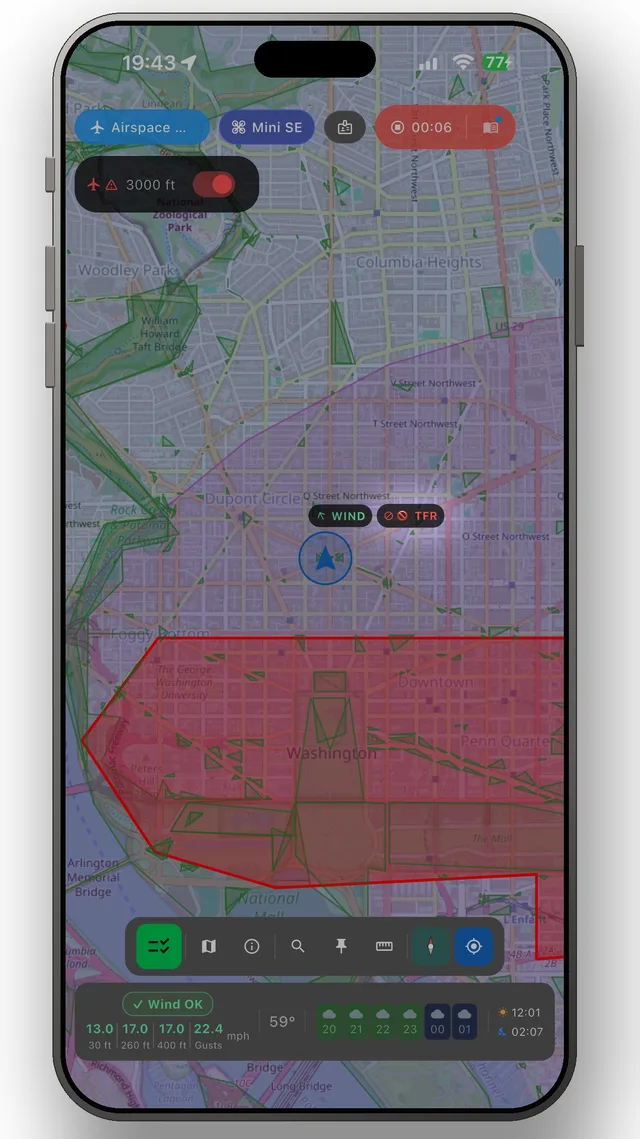
The hard stops are the control zones around airports, protected sites such as military bases, prisons and power plants, and many nature reserves and national parks where the county board has banned drones. All of it appears as zones on the map on this page — and the DroneKoll app shows you live exactly which zones apply where you are standing, including temporary restrictions (NOTAMs) that never show up on static maps.
Who regulates drone flying in Sweden?
Transportstyrelsen — the Swedish Transport Agency — sets the rules; that is where you take the drone certificate and register as an operator. LFV, the air navigation service, manages the airspace itself and runs the official drone map. The foundation is the EU's common drone regulation, which Sweden has complemented with national rules. Both authorities' official pages are linked under Sources below.
Good to know
OFFICIAL SOURCES
- Swedish Transport Agency — Drone Regulationstransportstyrelsen.se
- LFV Drone Map — Airspacedronechart.lfv.se
- Operator Registration (required for ≥250 g or camera, 250 kr/year)dronarsidan.transportstyrelsen.se
- Drone Certificate A1/A3 — Online Theory Test (requires ≥250 g, ages 15 and up)transportstyrelsen.se
ADVANCED / SPECIAL CASES
Always check official sources before flying. This page is a guide — not a legal authority. Rules are subject to change without notice.
The app
The whole picture, up to date — in your pocket
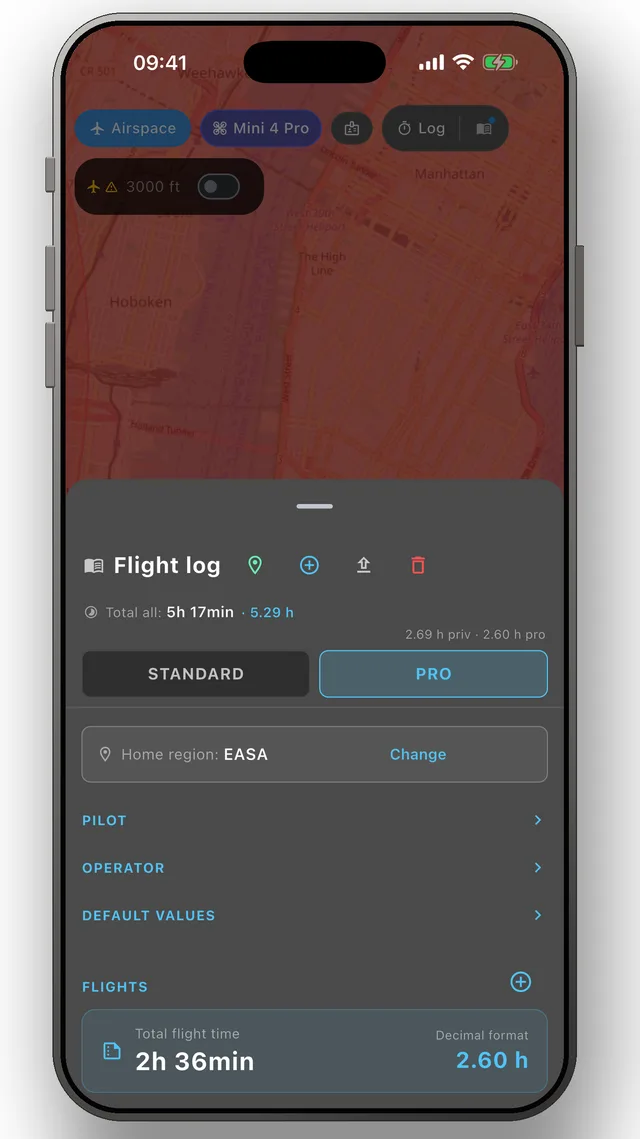
DroneKoll shows no-fly zones, weather and NOTAMs on one interactive map — with a flight log and checklists built in.
More in the app:Interactive zone map · Flight log · Planning & measuring · Pre-flight checklists · Flying abroad