Can you fly your drone in Belgium?
Whether you can fly depends on your drone, your registration and exactly where you fly. Here is what applies: key rules, no-fly zones and the official sources, in one place.
Regulator
BCAA (Belgian Civil Aviation Authority)
Framework
EU 2019/947 (EASA Open Category) + national enforcement framework
Pilot credential
A1/A3 Drone License
KEY RULES (EASA OPEN CATEGORY)
- In the open category the maximum height is 120 m, measured as the distance to the closest point of the Earth's surface — not simply straight down, so near a slope the ground beside you can also count. Within 50 m of a tall artificial obstacle (higher than 105 m), the maximum height may be increased up to 15 m above the height of the obstacle at the request of the entity responsible for the obstacle.
- You must register as a UAS operator if your drone weighs 250 g or more (or could transfer more than 80 J of kinetic energy in a collision) — this also applies to toys. Below 250 g, registration is still required if the drone has a sensor able to capture personal data, unless it counts as a toy under the EU Toy Safety Directive. Register in the EU/EASA country where you live (if you live outside it: in the first EU/EASA country where you will fly); that registration is valid in all EU/EASA countries. Pilot training/certificate requirements are set separately and depend on the drone's class and subcategory.
- In Belgium the minimum age for subcategories A1/A3 is 14 — the free online training and exam are valid for 5 years and recognised EU-wide. For subcategory A2 the minimum age remains 16. Exceptions to the age-14 limit: no minimum age for a C0 drone that is a toy (EU Toy Safety Directive) in A1, for a privately built drone under 250 g, or under the direct supervision of a pilot aged at least 16 who holds the required certificate.
- Liability insurance (injury and property damage to third parties) is mandatory in the open category, except for drones under 900 g used only privately. From 20 kg, the requirements of Regulation (EC) No 785/2004 apply.
- Foreign pilots: registration and an A1/A3/A2 certificate from another EU member state are valid in Belgium; carry your proof of registration and display your operator number on the drone. Belgian geozones and the Belgian insurance requirement (except private use under 900 g) also apply to you.
- Brussels: in geozone EBR-01 you need prior permission from the institution concerned to fly over or within 50 m of embassies and federal and international (including EU) institutions. Also check the Brussels Airport CTR conditions on Droneguide and the municipal rules if you want to take off from or film in a public place.
- In the open category you must keep the drone within your own line of sight, with the naked eye (glasses/contact lenses are fine; binoculars or a screen do not count) — or fly with the help of an observer, with the two of you communicating clearly and effectively at all times, so that together you can monitor the airspace and avoid collisions. Follow-me mode in subcategory A1 is a separate exception, permitted up to 50 m from the pilot.
- Drones without a class label (placed on the market before 2024): under 250 g in A1, otherwise only in A3 and max. 25 kg (min. 150 m from residential, commercial, industrial or recreational areas). Without a class label and placed on the market after 31-12-2023: not in the open category.
- Do not fly over assemblies of people. Rules for uninvolved persons depend on subcategory, class mark and operating conditions; check the official matrix.
- There is no uniform EU-wide distance from airports; the shape and size of geozones differ per airport. Geozones apply in a Belgian CTR (see Droneguide): in VLL 0 around the runways the open category is prohibited; in VLL 1 and VLL 2 max. 150 ft (approx. 45 m) above the ground (in VLL 1 also no higher than the highest obstacle within 100 m). VLL 1: prior permit required; VLL 2: notify the flight at least 3 hours in advance. Apply via the skeyes DAA-planner; staying reachable by phone, geo-awareness and Remote ID are mandatory (Remote ID not for C0 and certain drones under 250 g).
- Night flight is permitted under the EASA open-category baseline when the required green flashing light is used, unless a current geographic zone or national rule imposes a stricter condition.
- Check Droneguide for zone-specific altitude limits and restrictions
No-fly zones and restrictions

Frequently asked questions
Do I need a licence or certificate to fly a drone in Belgium?
Two separate things are easily confused here. Registration as a drone operator is required as soon as your drone weighs 250 g or more, or has a camera or sensor able to capture personal data — so it covers many sub-250 g drones too, unless they qualify for the toy exemption. The remote pilot's certificate of competency (A1/A3 Drone License) is something else: you need it once your drone weighs 250 g or more, or carries a C1 or higher class mark. A camera drone under 250 g therefore needs registration, but no exam. You get the certificate by passing an online theory test with BCAA (Belgian Civil Aviation Authority), and it is then valid across the whole EASA area, not just here.
Can I fly a drone as a tourist or foreign visitor in Belgium?
Yes — EU drone rules apply to visitors too. If you are already registered as a drone operator in another EASA country, that registration and your A1/A3 certificate (also A2) are valid in Belgium as well. Coming from outside the EASA area, you register once — in the first EASA country where you plan to fly, here with BCAA (Belgian Civil Aviation Authority). Belgium requires third-party liability insurance for open-category drone flights — a national rule stricter than the EU baseline. Drones with a take-off weight under 900 g that are flown only for private purposes are exempt. If you need cover, check that your policy covers flights in Belgium.
What are the most important drone rules in Belgium?
The short version: In the open category the maximum height is 120 m, measured as the distance to the closest point of the Earth's surface — not simply straight down, so near a slope the ground beside you can also count. Within 50 m of a tall artificial obstacle (higher than 105 m), the maximum height may be increased up to 15 m above the height of the obstacle at the request of the entity responsible for the obstacle. On top of that: You must register as a UAS operator if your drone weighs 250 g or more (or could transfer more than 80 J of kinetic energy in a collision) — this also applies to toys. Below 250 g, registration is still required if the drone has a sensor able to capture personal data, unless it counts as a toy under the EU Toy Safety Directive. Register in the EU/EASA country where you live (if you live outside it: in the first EU/EASA country where you will fly); that registration is valid in all EU/EASA countries. Pilot training/certificate requirements are set separately and depend on the drone's class and subcategory. Also: In Belgium the minimum age for subcategories A1/A3 is 14 — the free online training and exam are valid for 5 years and recognised EU-wide. For subcategory A2 the minimum age remains 16. Exceptions to the age-14 limit: no minimum age for a C0 drone that is a toy (EU Toy Safety Directive) in A1, for a privately built drone under 250 g, or under the direct supervision of a pilot aged at least 16 who holds the required certificate. These are central aviation rules — location-specific airspace, land, nature, privacy and photography requirements can also apply in Belgium, so always check the official sources.
Where am I not allowed to fly a drone in Belgium?
What you need to avoid are the restricted zones — typically around airports, prisons, military areas and protected nature areas. You'll find the official map for Belgium under Sources below, and the DroneKoll app shows current NOTAMs (temporary airspace restrictions) for Belgium.
Who regulates drone flying in Belgium?
Drone flying in Belgium is regulated by BCAA (Belgian Civil Aviation Authority). The airspace itself is managed by skeyes. You will find both organisations' official pages under Sources below — those are the links worth bookmarking.
Good to know
OFFICIAL SOURCES
- BCAA — Drone RulesOfficial Belgian civil aviation authority with drone regulations and informationmobilit.belgium.be
- BCAA — Register as an operatorRegister as a UAS operator (valid in all EU/EASA countries)drones.mobilit.fgov.be
- Droneguide — Airspace MapOfficial interactive map showing drone zones, restrictions, and flight conditionsmap.droneguide.be
- BCAA — Training and ExamsInformation about A1/A3 and A2 courses and examsmobilit.belgium.be
ADDITIONAL RESOURCES
Always check the official BCAA sources and Droneguide before flying. This page is a guide — not a legal authority. Belgium follows EASA regulations, supplemented by national rules (including mandatory insurance and fixed geographical zones).
The app
The whole picture, up to date — in your pocket
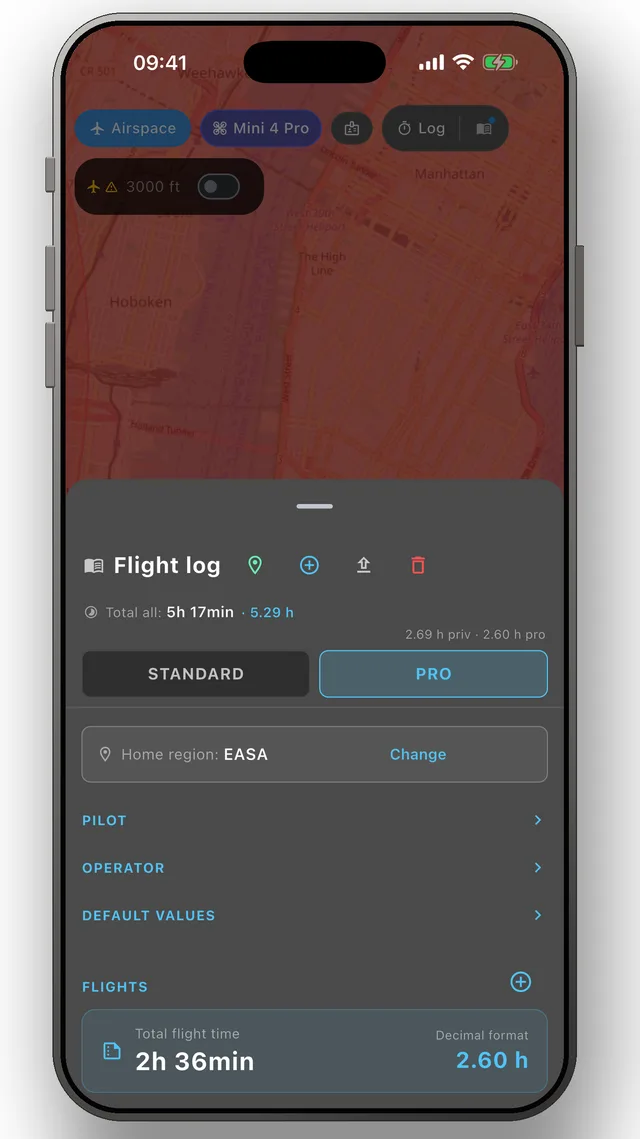
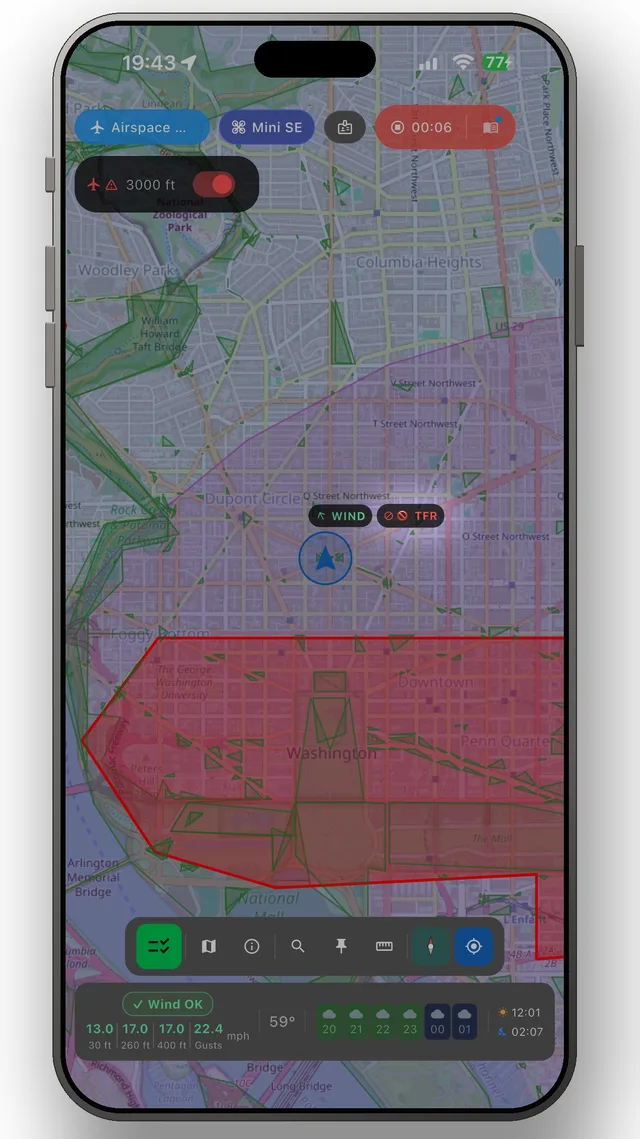
DroneKoll shows weather and current NOTAMs on the map — with a flight log and checklists built in.
More in the app:Interactive zone map · Flight log · Planning & measuring · Pre-flight checklists · Flying abroad