Can you fly your drone in Germany?
Whether you can fly depends on your drone, your registration and exactly where you fly. Here is what applies: key rules, no-fly zones and the official sources, in one place.
Regulator
Luftfahrt-Bundesamt (LBA)
Framework
EU 2019/947 (EASA Open Category) + LuftVO §§ 21a–21j
Pilot credential
Drone License
Mapped zones
55,958
IMPORTANT RULES
- In the open category, the maximum height is 120 m, measured as the distance to the closest point of the Earth's surface — not simply straight down, so near a slope the ground beside you can also count. Within 50 m of a tall artificial obstacle (over 105 m), the maximum height may be increased up to 15 m above the height of the obstacle at the request of the entity responsible for the obstacle.
- You must register as a drone operator if your drone weighs 250 g or more (or could transfer more than 80 J of kinetic energy on impact) — this also applies to toys. Below 250 g, registration is still required if the drone has a sensor capable of capturing personal data, unless it is considered a toy under the EU Toy Safety Directive. Pilot training/competency requirements are regulated separately and depend on the drone's class and subcategory.
- LBA operator registration is subject to a fee — minimum age is 16. The registration number (e-ID) must be clearly visible on the drone.
- In Germany, the minimum age for the A1/A3 proof of competency is 16 (online training and exam, 40 questions from 9 subject areas, 75% to pass, valid for 5 years) — exception: flying under the direct supervision of a remote pilot with a valid certificate.
- Mandatory liability insurance (§43 Luftverkehrsgesetz) — also applies to recreational drones, regardless of weight.
- Flying over residential properties without the explicit consent of the owners or other authorized users is prohibited (§21h LuftVO). Exceptions: drones under 250 g without recording/transmission capability, or flights at 100 m altitude or higher under several conditions (legitimate interest, no public area available, consent cannot reasonably be obtained, data protection precautions, only between 06:00 and 22:00, noise limits observed).
- Within 100 m (laterally and above) of federal trunk roads, federal waterways and railway facilities, operation is only permitted if ONE of the conditions of § 21h Abs. 3 Nr. 5 LuftVO is met: a) overflight of a road or railway facility in the "specific" category with a risk assessment that accounts for the particular hazards of the overflight; b) explicit consent of the competent authority or the operator of the facility; c) the flight height above ground is always less than the lateral distance to the infrastructure, and this distance is always greater than 10 m; or d) for federal waterways: crossing by the shortest route at a height of at least 100 m, without flying over ships or shipping facilities. For industrial facilities, prisons, military facilities and energy facilities, the 100 m distance applies unless the competent authority or the operator of the facility gives explicit consent (Nr. 3). For railway facilities, DB InfraGO AG has published the requirements for railway-compatible UAS operation in NfL 1-2026-3788.
- Nature reserves, national parks and Natura 2000 areas: overflight is prohibited (§ 21h Abs. 3 Nr. 6 LuftVO) unless the competent nature conservation authority explicitly consents or state law regulates operation differently. Outside national parks, operation is also permitted if all four conditions are met at the same time: no sporting or recreational purpose, flight height above 100 m, knowledge and appropriate consideration of the protection purpose, and the overflight is unavoidably necessary for the purpose of the operation.
- ED-R 146: permanent restricted area over Berlin's government district — permission required. Check the current status on dipul.de before flying.
- As of August 6, 2026, the zone model for UAS flights in control zones applies at 24 airports (DFS: NfL 2026-1-3960, which repeals NfL 2023-1-2705; DFS Aviation Services: NfL 2026-1-3981). Zone 1 — above the airport, within 1 km of its boundary, and in the runway corridors extended by 5 km (1 km each to the left and right of the runway centerline) — has no general clearance: an individual air traffic control clearance is always required there, applied for via ais.dfs.de with about 14 days' lead time. In zones 2 and 3, a general clearance applies up to 25 m and 45 m respectively above aerodrome elevation or above ground (whichever is lower); in zone 4 up to 100 m above aerodrome elevation or 50 m above ground (whichever is higher; if the take-off point is below aerodrome elevation, 100 m above ground applies). The general clearance only applies to UAS up to 25 kg (model aircraft up to 5 kg), requires a ground visibility of at least 800 m and excludes autonomous flights. Check your sub-zone and the terrain elevation in the dipul Maptool before flying.
- Direct Remote ID has been mandatory EU-wide for C1, C2, and C3 class drones since January 1, 2024
No-fly zones and restrictions
55,958 zones · updated daily
Frequently asked questions
Do I need a licence or certificate to fly a drone in Germany?
Two separate things are easily confused here. Registration as a drone operator is required as soon as your drone weighs 250 g or more, or has a camera or sensor able to capture personal data — so it covers many sub-250 g drones too, unless they qualify for the toy exemption. The remote pilot's certificate of competency (Drone License) is something else: you need it once your drone weighs 250 g or more, or carries a C1 or higher class mark. A camera drone under 250 g therefore needs registration, but no exam. You get the certificate by passing an online theory test with Luftfahrt-Bundesamt (LBA), and it is then valid across the whole EASA area, not just here.
Can I fly a drone as a tourist or foreign visitor in Germany?
Yes — EU drone rules apply to visitors too. If you are already registered as a drone operator in another EASA country, that registration and your A1/A3 certificate (also A2) are valid in Germany as well. Coming from outside the EASA area, you register once — in the first EASA country where you plan to fly, here with Luftfahrt-Bundesamt (LBA). Germany requires aviation liability insurance for every drone, with no weight exemption — even sub-250 g models — and you must carry proof when flying. Foreign hobby policies often exclude this, so verify coverage for Germany before you go.
What are the most important drone rules in Germany?
The short version: In the open category, the maximum height is 120 m, measured as the distance to the closest point of the Earth's surface — not simply straight down, so near a slope the ground beside you can also count. Within 50 m of a tall artificial obstacle (over 105 m), the maximum height may be increased up to 15 m above the height of the obstacle at the request of the entity responsible for the obstacle. On top of that: You must register as a drone operator if your drone weighs 250 g or more (or could transfer more than 80 J of kinetic energy on impact) — this also applies to toys. Below 250 g, registration is still required if the drone has a sensor capable of capturing personal data, unless it is considered a toy under the EU Toy Safety Directive. Pilot training/competency requirements are regulated separately and depend on the drone's class and subcategory. Also: LBA operator registration is subject to a fee — minimum age is 16. The registration number (e-ID) must be clearly visible on the drone. These are central aviation rules — location-specific airspace, land, nature, privacy and photography requirements can also apply in Germany, so always check the official sources.
Where am I not allowed to fly a drone in Germany?
What you need to avoid are the restricted zones — typically around airports, prisons, military areas and protected nature areas. You'll find the official map for Germany under Sources below, and the DroneKoll app shows current NOTAMs (temporary airspace restrictions) for Germany.
Who regulates drone flying in Germany?
Drone flying in Germany is regulated by Luftfahrt-Bundesamt (LBA). The airspace itself is managed by DFS Deutsche Flugsicherung. You will find both organisations' official pages under Sources below — those are the links worth bookmarking.
Good to know
OFFICIAL SOURCES
- dipul – Official Drone MapDFS Map Tool for Airspace Classes, Restricted Areas, and Permitsmaptool-dipul.dfs.de
- LBA – Registration & Remote Pilot CertificatesMandatory registration from 250 g, EU proof of competency (A1/A3) and EU remote pilot certificate (A2)lba.de
- Droniq – TraX Drone AppDrone app: check geozones, keep an eye on air traffic and log your flightsdroniq.de
ADVANCED / SPECIAL CASES
- DFS – NOTAM QueryOfficial NOTAM bulletins from German Air Traffic Controlais.dfs.de
- BfN – Protected Areas (Natura 2000)Nature Reserves, National Parks, and EU Protected Areasgeodienste.bfn.de
- LBA – Operational AuthorizationsApply for an operational authorization for the "specific" categorylba.de
- BMV – Drone InformationNational drone regulation and legal basis (§21h LuftVO)bmv.de
Always check official sources before your flight. This page is a guide — not a legal authority. Rules are subject to change without notice.
The app
The whole picture, up to date — in your pocket
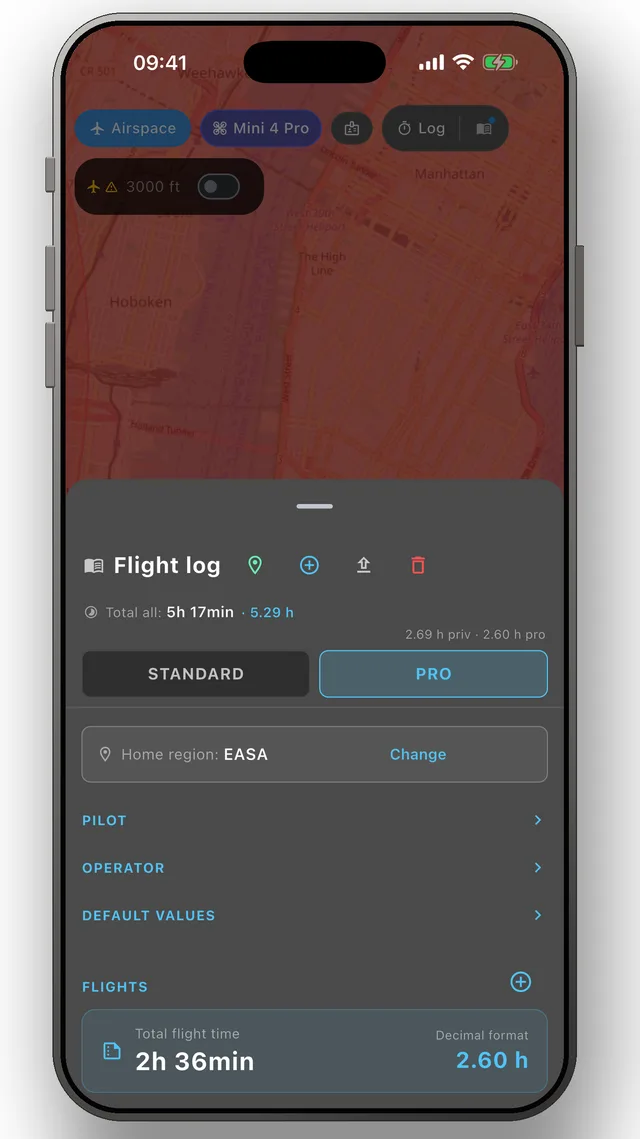
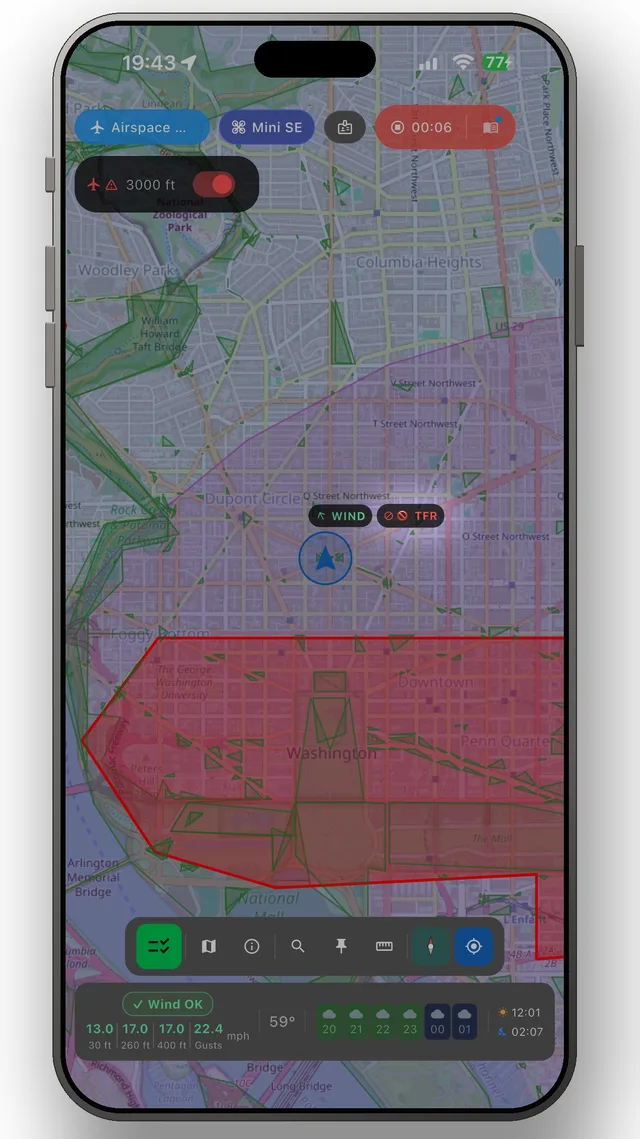
DroneKoll shows no-fly zones, weather and NOTAMs on one interactive map — with a flight log and checklists built in.
More in the app:Interactive zone map · Flight log · Planning & measuring · Pre-flight checklists · Flying abroad