Can you fly your drone in the Czech Republic?
Whether you can fly depends on your drone, your registration and exactly where you fly. Here is what applies: key rules, no-fly zones and the official sources, in one place.
Regulator
Úřad pro civilní letectví (ÚCL)
Framework
EU 2019/947 (EASA Open Category) + national enforcement framework
Pilot credential
A1/A3 training certificate
KEY RULES (EASA OPEN CATEGORY)
- In the open category the maximum height is 120 m, measured as the distance to the closest point on the Earth's surface — not simply straight down, so near a slope the ground beside you can count too. Within 50 m of a tall artificial obstacle (over 105 m), the maximum height may be increased up to 15 m above the height of the obstacle at the request of the entity responsible for the obstacle.
- You must register as a drone operator if your drone weighs 250 g or more (or could transfer more than 80 J of kinetic energy on impact) — this applies to toys too. Below 250 g, registration is still mandatory if the drone has a sensor able to capture personal data, unless it is considered a toy under the EU Toy Safety Directive. Training/pilot licence requirements are separate and depend on the drone's class and subcategory.
- The minimum age for flying on your own in the open category is 16 — the A1/A3 online training and exam are valid for 5 years and recognised throughout the EU. No age limit: a class C0 drone that is a toy, in subcategory A1, or a privately built drone under 250 g; otherwise younger pilots only under the direct supervision of a pilot who meets the age and training requirements.
- Tourists: operator registration and an A1/A3 certificate from another EU/EASA country are also valid in the Czech Republic (you can register in only one country). Outside the EU: register in the first EU/EASA country where you will fly (in the Czech Republic with ÚCL at dron.caa.gov.cz), and if your drone requires training, complete training under EU rules – certificates from non-EU countries are not recognised.
- Liability insurance is mandatory in the Czech Republic in subcategory A2 and in A3 for drones over 4 kg (not in A1) — check that your policy covers flights in the Czech Republic.
- In airport CTRs and ATZs you may fly without coordination only up to the height set by the grid (check in DroneMap). Higher only after coordination with ŘLP and with the flight marked in DroneMap; in the inner zone of a CTR the flight must always be marked in DroneMap, and above the grid height coordination with the airport operator is also required. Stricter conditions apply at military airports (MCTR). At uncontrolled airports, above the grid height only after coordination with AFIS or the airport operator. Marking in DroneMap does not apply to drones that do not require registration.
- In densely populated areas (zone LKR316) the flight area must be marked in advance in DroneMap (dronemap.gov.cz). The marking (here as well as in CTRs and protected nature areas) must include the height, time, type and weight category of the drone, and the operator's registration number. Does not apply to drones for which operator registration is not required.
- National parks, protected landscape areas (CHKO) and small-scale protected areas, e.g. nature reserves (zone LKR318): flights only on the basis of prior notification to, or permission from, the competent nature conservation authority, and with the flight area marked in DroneMap. Does not apply to drones for which operator registration is not required.
- Roads (zone LKR317): as a rule, within 50 m of the centreline of a motorway or class I road only with the consent of ŘSD; as a rule, within 15 m of the centreline of class II and III roads only with the consent of the road's owner or manager (similarly for local roads outside densely populated areas). The flight area must be marked in DroneMap – does not apply to drones for which operator registration is not required.
- In the open category you must keep the drone in direct visual line of sight with the naked eye (glasses/contact lenses are fine; binoculars or a screen do not count) — or bring in an observer to help, with clear and effective communication between you at all times, so that together you can watch the airspace and avoid collisions. “Follow-me” mode is a separate exception only in subcategory A1, permitted within 50 m of the pilot.
- Do not fly over assemblies of people. Rules for uninvolved persons depend on subcategory, class mark and operating conditions; check the official matrix.
- Do not fly under the influence of alcohol or another addictive substance, nor in or near the area of an operation by units of the Integrated Rescue System – both are offences in the Czech Republic (§ 92c of Act No. 49/1997 Coll.). Policie ČR and ÚCL may require you to prove your identity, present your certificate, undergo a preliminary test for addictive substances and interrupt the flight; you must comply with the request.
- Night flight is permitted under the EASA open-category baseline when the required green flashing light is used, unless a current geographic zone or national rule imposes a stricter condition.
- Fines of up to 3,000,000 CZK (≈ 120,000 €) for violations
- Prague: prohibited areas for drones LKP1 PRAŽSKÝ HRAD, LKP329 VLTAVA (the tourist-heavy part of Prague) and LKP330 DEJVICE. In LKP329 and LKP330 you may fly only with a specific-category authorisation or a flight authorisation from ÚCL and with the prior consent of Policie ČR (for LKP330, the Military Police); in LKP1 only under the conditions of AIP ENR 5 and ÚCL procedures and with the consent of Policie ČR. Check the boundaries in DroneMap.
No-fly zones and restrictions

Frequently asked questions
Do I need a licence or certificate to fly a drone in the Czech Republic?
Two separate things are easily confused here. Registration as a drone operator is required as soon as your drone weighs 250 g or more, or has a camera or sensor able to capture personal data — so it covers many sub-250 g drones too, unless they qualify for the toy exemption. The remote pilot's certificate of competency (A1/A3 training certificate) is something else: you need it once your drone weighs 250 g or more, or carries a C1 or higher class mark. A camera drone under 250 g therefore needs registration, but no exam. You get the certificate by passing an online theory test with Úřad pro civilní letectví (ÚCL), and it is then valid across the whole EASA area, not just here.
Can I fly a drone as a tourist or foreign visitor in the Czech Republic?
Yes — EU drone rules apply to visitors too. If you are already registered as a drone operator in another EASA country, that registration and your A1/A3 certificate (also A2) are valid in the Czech Republic as well. Coming from outside the EASA area, you register once — in the first EASA country where you plan to fly, here with Úřad pro civilní letectví (ÚCL). Czechia adds a national insurance rule: liability cover is required for A2 flights and for drones over 4 kg flown in A3 (light A1 drones are exempt). Make sure your policy covers flights in Czechia.
What are the most important drone rules in the Czech Republic?
The short version: In the open category the maximum height is 120 m, measured as the distance to the closest point on the Earth's surface — not simply straight down, so near a slope the ground beside you can count too. Within 50 m of a tall artificial obstacle (over 105 m), the maximum height may be increased up to 15 m above the height of the obstacle at the request of the entity responsible for the obstacle. On top of that: You must register as a drone operator if your drone weighs 250 g or more (or could transfer more than 80 J of kinetic energy on impact) — this applies to toys too. Below 250 g, registration is still mandatory if the drone has a sensor able to capture personal data, unless it is considered a toy under the EU Toy Safety Directive. Training/pilot licence requirements are separate and depend on the drone's class and subcategory. Also: The minimum age for flying on your own in the open category is 16 — the A1/A3 online training and exam are valid for 5 years and recognised throughout the EU. No age limit: a class C0 drone that is a toy, in subcategory A1, or a privately built drone under 250 g; otherwise younger pilots only under the direct supervision of a pilot who meets the age and training requirements. These are central aviation rules — location-specific airspace, land, nature, privacy and photography requirements can also apply in the Czech Republic, so always check the official sources.
Where am I not allowed to fly a drone in the Czech Republic?
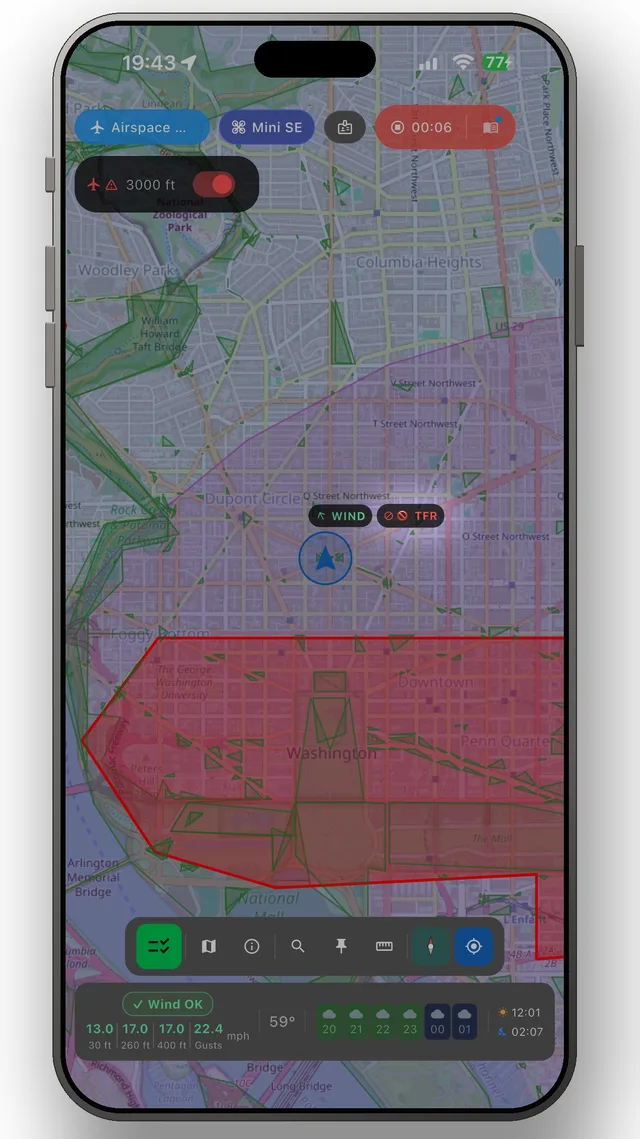
What you need to avoid are the restricted zones — typically around airports, prisons, military areas and protected nature areas. You'll find the official map for the Czech Republic under Sources below, and the DroneKoll app shows current NOTAMs (temporary airspace restrictions) for the Czech Republic.
Who regulates drone flying in the Czech Republic?
Drone flying in the Czech Republic is regulated by Úřad pro civilní letectví (ÚCL). The airspace itself is managed by ŘLP ČR (ANS CR). You will find both organisations' official pages under Sources below — those are the links worth bookmarking.
Good to know
OFFICIAL SOURCES
- ÚCL — Drone RegulationsOfficial Rules and Resources from the Civil Aviation Authority Regarding Dronescaa.gov.cz
- ÚCL — Operator RegistrationFree registration as a UAS operator (valid in all EU/EASA countries)dron.caa.gov.cz
- Dronemap.gov.cz — Airspace MapOfficial interactive map showing drone zones and airspace restrictionsdronemap.gov.cz
- ÚCL — Overview of RulesOverview of the Rules for Flying Drones in the Czech Republiccaa.gov.cz
ADDITIONAL RESOURCES
Before flying, always check the official sources of the Civil Aviation Authority (ÚCL) and Dronemap.gov.cz. This page is a guide — not a legal authority. The Czech Republic follows EASA regulations with national supplements.
The app
The whole picture, up to date — in your pocket
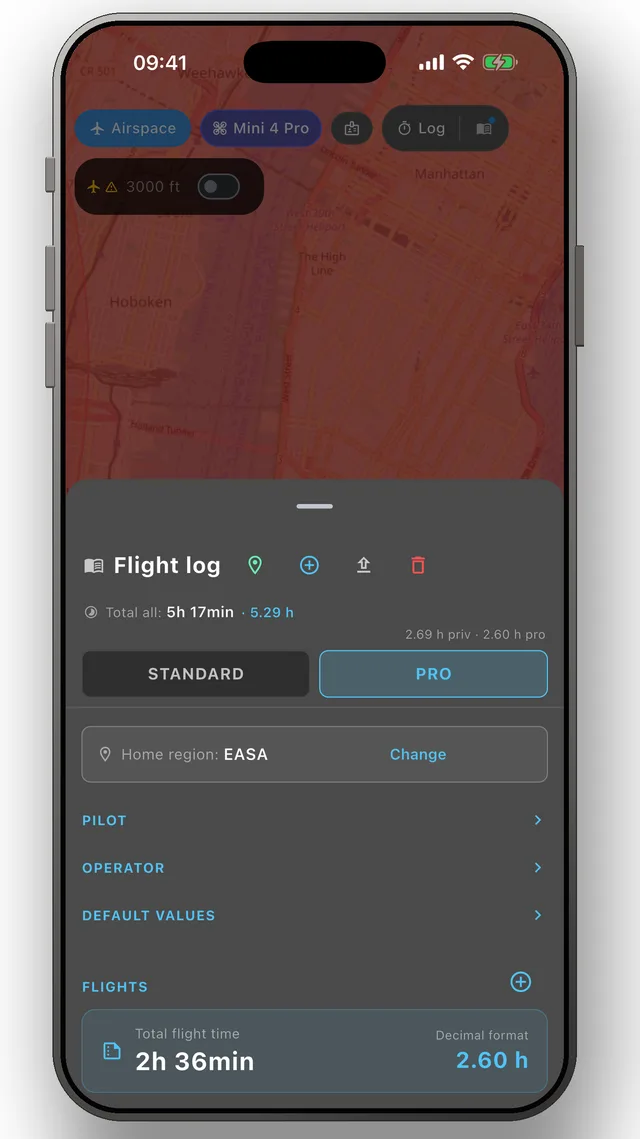
DroneKoll shows weather and current NOTAMs on the map — with a flight log and checklists built in.
More in the app:Interactive zone map · Flight log · Planning & measuring · Pre-flight checklists · Flying abroad